Tag: genetics

  • Editing DNA at Home?! What CRISPR Really Lets Us Do

    If you could change a single letter in your DNA, would anything actually happen?

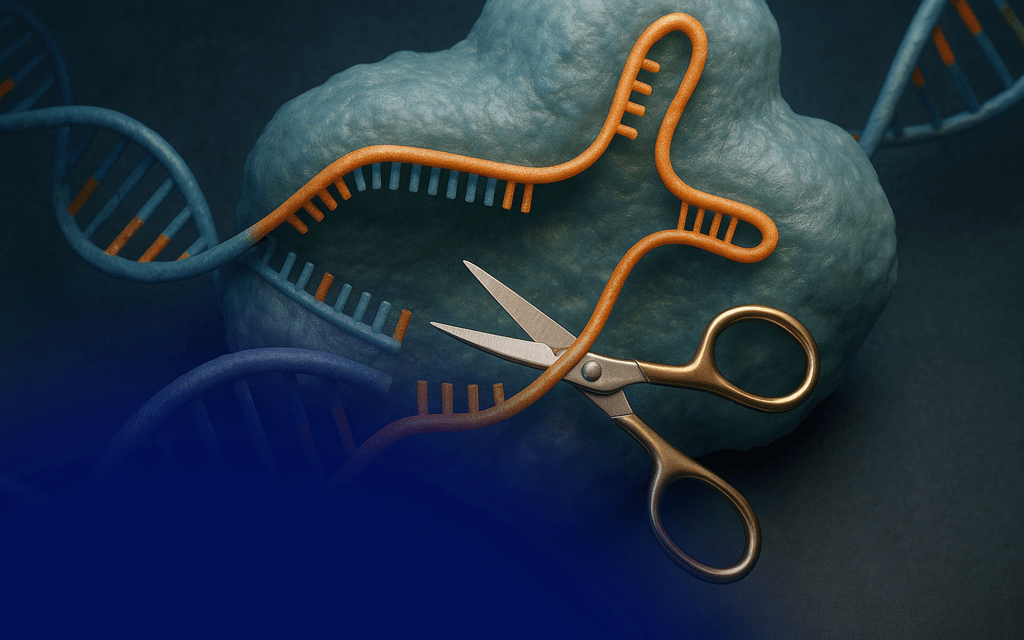
    That question sounds like science fiction, but modern biology has turned it into something astonishingly real. The tool behind this revolution is CRISPR: a molecular “find-and-edit” system borrowed from bacteria. In nature, bacteria use CRISPR as a defense system against viruses. In the lab, scientists realized the same machinery can be guided to almost any gene we want. Give it an address, and it goes there.

    That sounds dramatic, but here’s the wild part: this isn’t only happening in giant government labs.

    When I was 12, I did a CRISPR experiment at home.
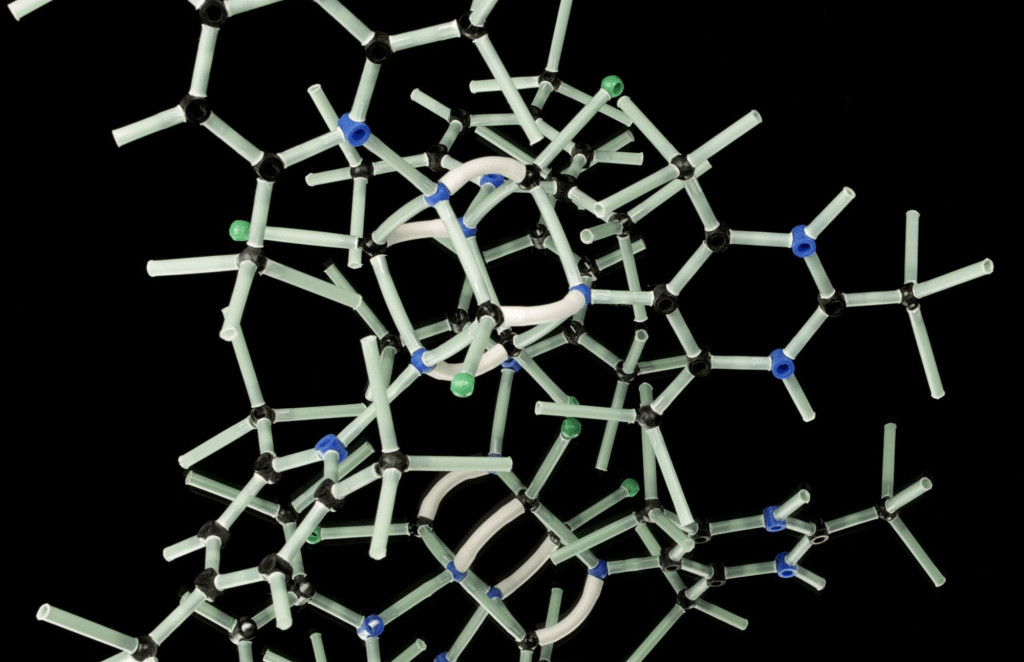
    Using an at-home educational kit from The ODIN, I edited a single gene in E. coli bacteria called rpsL. At one exact position in that gene, number 43, the normal bacteria have the amino acid lysine (K). With CRISPR, I changed that single amino acid to threonine (T). Scientists write that change as K43T.

    One letter in the DNA changed. One amino acid swapped.

    But the consequence was visible to the naked eye.

    Normally, harmless E. coli can’t grow on plates that contain the antibiotic streptomycin. After the mutation, the bacteria could grow. The K43T change altered the ribosomal protein targeted by the antibiotic, so the drug couldn’t stop the bacteria anymore. Same species, same cells, just one tiny change that made a huge difference in survival.

    Seeing colonies appear where nothing should have grown is a moment you don’t forget.

    And that’s really the magic of genetics: small changes can matter.

    CRISPR isn’t about instantly “designing” humans or making science-fiction monsters. It’s about precision. In the past, changing DNA was like throwing paint at a wall and hoping a droplet hit the right spot. CRISPR is closer to using a pen. It allows scientists to study diseases, build better crops, and understand how life works by changing one variable at a time.

    Of course, with power comes responsibility. Real CRISPR work requires thinking about safety, ethics, and rules, what should be edited, not just what can be edited. Many applications belong in controlled labs and under regulation. But what surprised me was how accessible the learning side is becoming.

    Educational biotech kits now exist so students can explore genetics safely, legally, and hands-on. The ODIN kit I used didn’t create anything dangerous or exotic. What it did create was curiosity: the feeling of: I can understand this. I can do science.

    If you’re interested in genetics, I genuinely recommend exploring kits like that. Not because they turn you into a “gene editor overnight,” but because they transform biology from words in a textbook into something alive and testable. Watching living cells respond to a single genetic change teaches you more than five chapters of notes ever could.

    CRISPR is not magic. It’s a tool.

    The real magic is realizing that life is written in a code, that the code can change, and that we now have a way to read it, and sometimes even rewrite a letter.

    And that journey can start earlier, and be more accessible, than most people think.
  • The Myth of “Normal” DNA

    I keep coming back to this idea that there’s no such thing as a “normal” genome. It sounds philosophical, but the more I dig into the data, the more literal it becomes. Humans love patterns, order, and clean categories, but our DNA doesn’t cooperate. It’s far more chaotic than anyone imagines.

    When the first full genome was sequenced in the early 2000s, people acted like scientists had uncovered the “official” human blueprint. But that sequence mostly came from one anonymous guy in Buffalo, New York, plus a few additional samples to fill in gaps. That random person became the reference map for billions of people. Not because his genome was special: it was just the first one someone decoded.

    Now that thousands of genomes have been sequenced, the picture looks completely different. The average person carries 3 to 5 million genetic variants compared to that reference. Out of those, around 20,000 to 30,000 change amino acids in proteins. And here’s the part I still find wild: each of us carries dozens of “potentially damaging” mutations that, on paper, look like they should cause disease, yet most people live perfectly healthy lives. Biology isn’t fragile. It’s resilient in ways we barely understand.

    There are also these things called copy number variations, chunks of DNA where some people have one copy, others have three, some have none at all. A single region can be duplicated in one person and missing entirely in another, and both individuals are still walking around, functioning normally, never knowing their genomes are structurally different.

    Even entire gene losses aren’t rare. There are well-documented cases of people missing functional versions of genes like CCR5 (which protects against HIV) or UCP1 (involved in thermogenesis), and they’re completely fine. Evolution seems to care less about perfect DNA and more about whether the organism can push through the day.

    And then there’s the viral stuff: about 8% of our genome is made of fossilized viruses that infected our ancestors. Some of these ancient viral genes even got repurposed by our cells; one of them, syncytin, helps form the human placenta. So the structure growing an entire human life literally depends on a retrovirus that integrated into our genome millions of years ago.

    All of this makes the idea of a “normal” genome feel almost comical. There is no standard version of being human. There’s just a long spectrum of variation, millions of tiny differences layered on top of each other, none of them representing a mistake, just diversity.

    I find it kind of freeing.

    You’re not a slightly imperfect copy of some ideal genetic blueprint.

    You are the blueprint: your own unique, messy, functioning version of it.

    If anything, genetics keeps repeating a quiet message that’s easy to overlook:

    normal isn’t a fixed state.

    Normal is whatever works.

  • Genetics and AI: Synthesis

    Scientists are learning more about how living things work than ever before by combining artificial intelligence (AI) and genetics in powerful ways. AI can quickly process a lot of data, and genetics gives us the basic structure of life. Together, they are opening up new ways to learn about health, disease, biology, and more specifically the p53 protein.

    AlphaFold by DeepMind is one example of a technology that uses AI and genetics together. It predicts the three-dimensional shapes of proteins based on their amino acid sequences. This tool is helping scientists learn more about how proteins work and how they are linked to different diseases. GeneFormer, a project by NVIDIA and Harvard, is another example. It uses deep learning to figure out how changes in DNA affect gene expression in different tissues, giving us more information about complicated genetic traits. Another AI-based tool that makes genetic testing more accurate is Google’s DeepVariant. It takes raw DNA sequencing data and turns it into more accurate genetic variant calls. Companies like Benson Hill use AI to look at plant genetics and make better crops with higher yields and better nutrition. These tools that work in the real world show that AI isn’t just a theory in genetics; it’s already being used and making a big difference.

    DeepMind made AlphaFold, which is one of the best examples of AI in biology. It was made to solve a long-standing problem in science: figuring out what shape a protein will take. Proteins are made up of chains of amino acids, and the shape of these chains affects how they work in the body. You can learn more about what a protein does and how it might cause disease or react to a drug if you know its shape. Before AlphaFold, it could take months or even years to figure out a protein’s structure using lab methods. AlphaFold can guess the shape of new proteins in just a few minutes by using deep learning models that have already been trained on known protein structures. DeepMind made a free database of more than 200 million protein structures available in 2021. This database includes almost all known proteins. Researchers have already used this resource to learn more about cancer, malaria, and antibiotic resistance. AlphaFold doesn’t just save time; it also makes it possible to find things that weren’t possible before. It is now used in drug design, enzyme engineering, and synthetic biology, among other fields.

    DeepVariant, which Google made, is another example from the real world. Deep learning, a type of AI, is used by this tool to make reading DNA more accurate. Scientists get a lot of short pieces of genetic code when they sequence DNA. It can be hard and error-prone to figure out exactly what the whole sequence looks like and where small changes, or variants, are. DeepVariant uses image-recognition-style methods to find mistakes and real genetic variants in the raw data more accurately than older methods. It works by turning sequencing data into pictures and then using a neural network to look at them, just like how AI can tell what things are in pictures. DeepVariant has been shown to work better than older tools, especially in hard-to-read parts of the genome. Researchers and hospitals can use this to make better diagnoses of genetic diseases, keep track of inherited traits, and even plan personalized treatments based on a person’s unique genetic profile.

    AlphaFold and DeepVariant together show how different AI tools can work together to help us learn more about genetics. DeepVariant makes it easier to read genes, while AlphaFold helps us understand what genes do by showing us the proteins they make and how they are built. We can use AlphaFold to figure out how changes in a person’s genome might affect the proteins in their body if DeepVariant gives us a better picture of that person’s genome. A small change in DNA, for instance, could change the shape of a protein in a way that makes it sick. Scientists can see exactly what went wrong because AlphaFold can model that shape. Researchers can now go from finding a genetic mutation to understanding how it affects molecules, which speeds up research and opens the door to new treatments. It also helps scientists find better connections between DNA and disease, which gives a fuller picture of how genetics affects health.

    This integrated approach is especially promising for analyzing critical proteins like p53, known as the “guardian of the genome.” DeepVariant can pinpoint subtle mutations in the TP53 gene, and AlphaFold can then simulate how these mutations deform the p53 protein’s structure, revealing, for instance, how it may fail to bind DNA or trigger cell death in cancerous cells. This kind of combined AI workflow could, in the near future, revolutionize our ability to detect structural damage in proteins like p53, either by scanning DNA for risky mutations or by directly modeling mutant proteins to spot hidden functional flaws. As these tools mature, they promise to redefine cancer research and diagnostics, bridging the gap between raw genetic data and precise, actionable molecular insights. Ultimately, they could lead us to earlier detection, smarter drug design, and more personalized treatment strategies rooted in a deep understanding of how our DNA shapes our health.